Home Physics Electrostatics Potential & Capacitance Capacitance Two parallel plate capacitors with different…
Physics Electrostatics Potential & Capacitance Capacitance Subjective Type
Published on: September 12, 2026

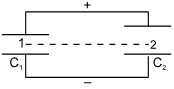
Two parallel plate capacitors with different distances between the plates are connected in parallel to a voltage source. A point positive charge Q is moved from a point 1 that is exactly in the middle between the plates of a capacitor C 1 to a point 2 (which lie in capacitor C 2 ) that lies at a distance from the negative plate of C 2 equal to half the distance between the plates of C 1 . Is any work done in the process? If yes, calculate the work done by the field if potential at 1 and 2 are V 1 and V 2 .
Share this question

For Instagram sharing, use “Apps” on mobile or copy the link.

Text Solution

Verified by Experts
The correct answer is:
A
Step 1: Understand the setup: There are two capacitors, C1 and C2, connected in parallel to a voltage source. A point charge, Q, is moved from the midpoint between the plates of capacitor C1 to a position within capacitor C2.

Step 2: Define the positions:
- Point 1 is at the midpoint of C1. Due to symmetry, the electric potential V1 at this point is calculated as:
$$ V_1 = V_{source} $$
- Point 2 is at a distance from the negative plate of C2 equal to half the distance between the plates of C1, hence the potential at this point, located in C2, can be denoted as V2.

Step 3: Work done by the electric field: The work done (W) on charge Q when moving from point 1 to point 2 is given by the formula:
$$ W = Q(V_2 - V_1) $$
Step 4: Identify whether there is a potential difference: If V1 and V2 are different, then work will be done. Since we assume that C2 has a different potential than C1, there is a work done.

Step 5: Calculation of work done: If the potentials are known, replace V1 and V2 appropriately. If the potentials are equal, W = 0. Thus the work done is expressed as:
$$ W = Q(V_2 - V_1) $$
Thus, depending on the values of V1 and V2, work can be done. Therefore:
Answer: Yes, work is done during the charge movement if V1 and V2 differ.

Prepare Smarter with CGP Edu

Get practice questions, solutions, and test series in one place.

Write a Review

Share your experience with this question and solution.

Commentary

Send your comment, doubt, correction, or feedback to admin.

Student Reviews

What students say about this solution

No reviews yet. Be the first to write a review.

Similar Questions

Explore conceptually related problems

CG
CGP Question Assistant Question Bank + AI Help
Hi! Type your question or upload one screenshot. First I will search related questions from CGP Edu Question Bank. If none match, type YES and I will solve it with AI.
Upload only one screenshot at a time. Flow: Question Bank first → If not matched, type YES for AI solution.